In collaboration (labelled MxN) with Mission: Mārama, Nakedize is proud to be designing and evolving a Universal AI Declaration (UAID) for Aotearoa New Zealand.
We recently socialised the UAID at the Aotearoa AI Summit in Wellington and are very grateful for the support of the Social Licence Workstream of the AI Forum for making this happen, and for their ongoing collaboration.
What is a Universal AI Declaration?
- A public statement that’s completed online
Any entity (from a sole trader to a multinational) declares why and how it uses AI. - Sections for Understanding, Commitments, Governance
Declaration sections covering common facts the organisation understands about AI, what it commits to achieving and avoiding, and how it’s governing its AI use. - A transparent promise that renews and evolves every 12 months
Commitments are renewed annually, so the public sees progress rather than promises.
Declaration prototypes
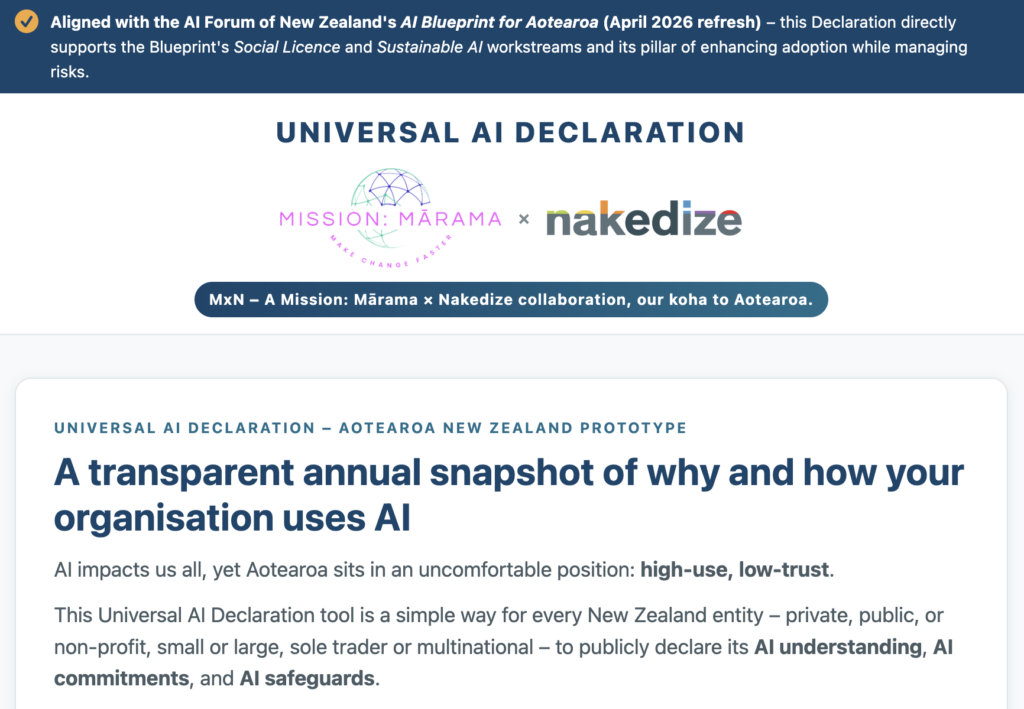
Having widely socialised our v6 prototype, we are currently developing a v7 prototype.
If you wish to review v6, please email simon@nakedize.com.
We have summarised feedback on v6 and plans and requests for help with v7 further below on this page.
Why is a declaration essential for responsible AI?
Trust doesn’t come from reports alone.
It comes from organisations saying out loud what they are doing and then being held accountable to their commitments.
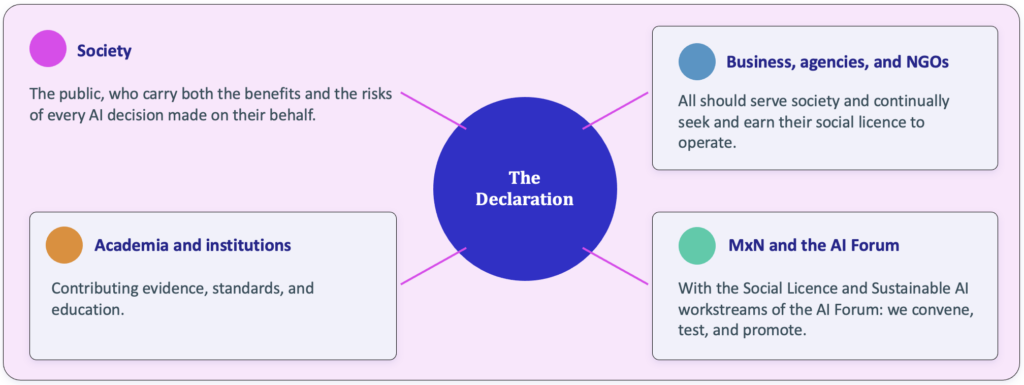
Who is involved?
How does the declaration work?
The Declaration has three sections:
- Understanding – 23 facts in 5 groups
A widely-sourced, plain-language baseline of what AI is and its societal impacts – both helpful and harmful - Intentions – 7 commitments
Responsible AI commitments built on the facts and in pursuit of AI for the benefit of all - Governance – 5 governance mechanisms and 7 guardrails
The mechanisms include a publicly accessible AI policy and the guardrails support each commitment
The Declaration is bound by a set of rules:
- One declaration per entity (regardless of entity size, thus ‘universal’)
- Renewed every 12 months
- AI policies must be publicly accessible
- The declaration is signed by a named, appropriately-authorised representative
What will change because of the UAID?
- During the first year engagement and dialogue begins so trust can grow.
- From the second year and beyond responsible AI performance improves and best practice spreads.
Who is behind the UAID?
MxN (comprising Mission Marama Ltd and Nakedize Ltd) is a collaboration for public-good sustainability projects related to information, AI, and social change. This work is a charitable project delivered as part of the Same Page Initiative.


Juhi Shareef, Mission: Mārama
Juhi is an AI entrepreneur and experienced sustainability practitioner. Her impact company is currently building an ethical AI collaboration platform for mission-driven groups. Her previous role was Chief Responsibility Officer for Tourism Holdings Limited. In May, Juhi served with Emma MacDonald and Albert Bifet on the panel discussion Beyond the Tools: Sustainable AI in Practiceat the AI and Creativity Summit in Wellington.
juhi@marama.global | marama.global | 020 4128 5586

Simon Hertnon, Nakedize
Simon is an author, educator, and thought leader shining a light on the impacts of unneeded information. He has just launched the Helpful Information Framework to expand and enhance plain language practice. In partnership with Victoria University of Wellington, Simon has taught writing skills to thousands of knowledge workers. He is also the inaugural head judge of the New Zealand and Australia Plain Language Awards.
simon@nakedize.com | nakedize.com | 027 573 4464
What feedback have we received on v6 and what are our responses?
Here’s a rough list :
- Is there a verification or challenge mechanism? (Because if claims were later shown to inaccurate or unsupported, the initiative could ultimately undermine rather than strengthen trust, ie, how do we avoid AI-washing?)
We have many ideas, all based on a strategy to apply sunlight (transparency) by enlisting millions of sets of eyes, facilitating feedback loops, and community-sharing the oversight load. See the next section for specific developments. - Potential to split education (or preparation) elements into a separate resource
We’re working on this framed by the principle that the UAID must be self-sufficient. - More concrete definition of AI computation
We’ll add or draw on the OECD definition: “An AI system is a machine-based system that, for explicit or implicit objectives, infers, from the input it receives, how to generate outputs such as predictions, content, recommendations, or decisions that can influence physical or virtual environments. Different AI systems vary in their levels of autonomy and adaptiveness after deployment. — OECD [https://legalinstruments.oecd.org/en/instruments/OECD-LEGAL-0449] - Useful for commitments to be more specific
We’re working on this. - Helpful to know the guardrails before making the commitments
We’re working on this.
What do we need help with as we develop v7 and subsequent versions?
Again, here’s a rough (non-exhaustive) list:
- We are concentrating on engagement and feedback loops because high participation breeds transparency, trust, and assurance. Thus we will:
- highlight that transparency is promoted by entities having a Staff concerns channel (G1 option 3) and Public concerns channel (G1 option 4)
- promote engagement and governance bright spots to inspire efficient, widespread improvement
- provide a platform or simple method for public feedback to fill gaps in, or supplement, existing staff and public feedback channels
- We are determined to avoid an exhaustive, overwhelming, effort-intensive oversight approach that drastically reduces engagement and participation (a la B-Corp). Instead, ours is a light-touch, fear-free pathway to both disclosure and engagement.
- We are exploring a peer review option (AI experts can be involved), so that entities completing the Declaration can request (pay for) peers to provide really valuable and up-to-date guidance on their draft declaration.
- We will add a persona-based (eg, sole trader, SME, corporation, public agency, academic institution) help and suggestions for completing the declaration, either in situ within the form, as a separate page, or as a combination.
How do you contribute feedback or put your hand up for more involvement?
Provide Juhi or Simon with your name and contact details, and we’ll email you a link to an online questionnaire covering:
- Optional feedback on the Declaration’s overall composition and three sections: Understanding, Commitments, and Governance
- Invitations to collaborate on parts or all of the declaration, and to become involved with promoting the UAID across Aotearoa
More questions?
Contact Juhi or Simon.