Kia ora
My name is Simon Hertnon and I would like to welcome you to the temporary home of the Helpful Information Network (helpfulinformation.net) presently hosted by my company, Nakedize Limited.
On this page, you will find the latest publicly-released version of a ‘helpful information’ framework I have developed as a sustainability initiative. The framework is intended to promote information that delivers societal value and, simultaneously, to expand and progress the practice and impact of plain language.
You will also find essential information about accessing and using the framework, along with background information about its genesis and evolution.
31 August 2026
Essential Q&As
- What is helpful information?
- Why is helpful information important?
- What is the Helpful Information Framework?
- Who is the framework for?
- How can the framework be used?
- Is there a management course to learn how to commission helpful information and manage its production?
- Is there a writing course to learn how to design and craft helpful information?
- Does Nakedize own the framework?
- Is the framework free for anyone to use, publish, or modify?
- What is the Helpful Information Network?
What is helpful information?
‘Helpful information’ is a new term to describe information that serves society.
Why is helpful information important?
Humans can consume only limited amounts of information.
If we expend our finite attention on information that does not serve society, then our capability, present welfare, and future prospects all suffer.
Helpful information is increasingly drowned out by unhelpful information.
Most unhelpful information is unnecessary, while some is also incorrect (misinformation) or misleading (disinformation). Unhelpful information wastes our time and incurs mounting financial, social, and ecological costs.
What is the Helpful Information Framework?
The Helpful Information Framework expands on common plain language qualities and practice through three key innovations covering qualities, roles, and purpose.
- It adds qualities that are important for, or essential to, creating information that delivers societal value
- It embeds all roles for responsibly producing helpful information
- leaders explicitly commissioning work
- managers efficiently managing information production and use
- writers confidently designing and crafting helpful information
- It anchors all effort on the overarching purpose of delivering value to society (after all, every business and organisation should serve society)
You can think of the framework and its aims as ‘plain language plus’.
The image below shows the first official version of the framework featuring 4 responsibilities (A–D), 3 roles (leaders, managers, writers), and 16 information qualities.
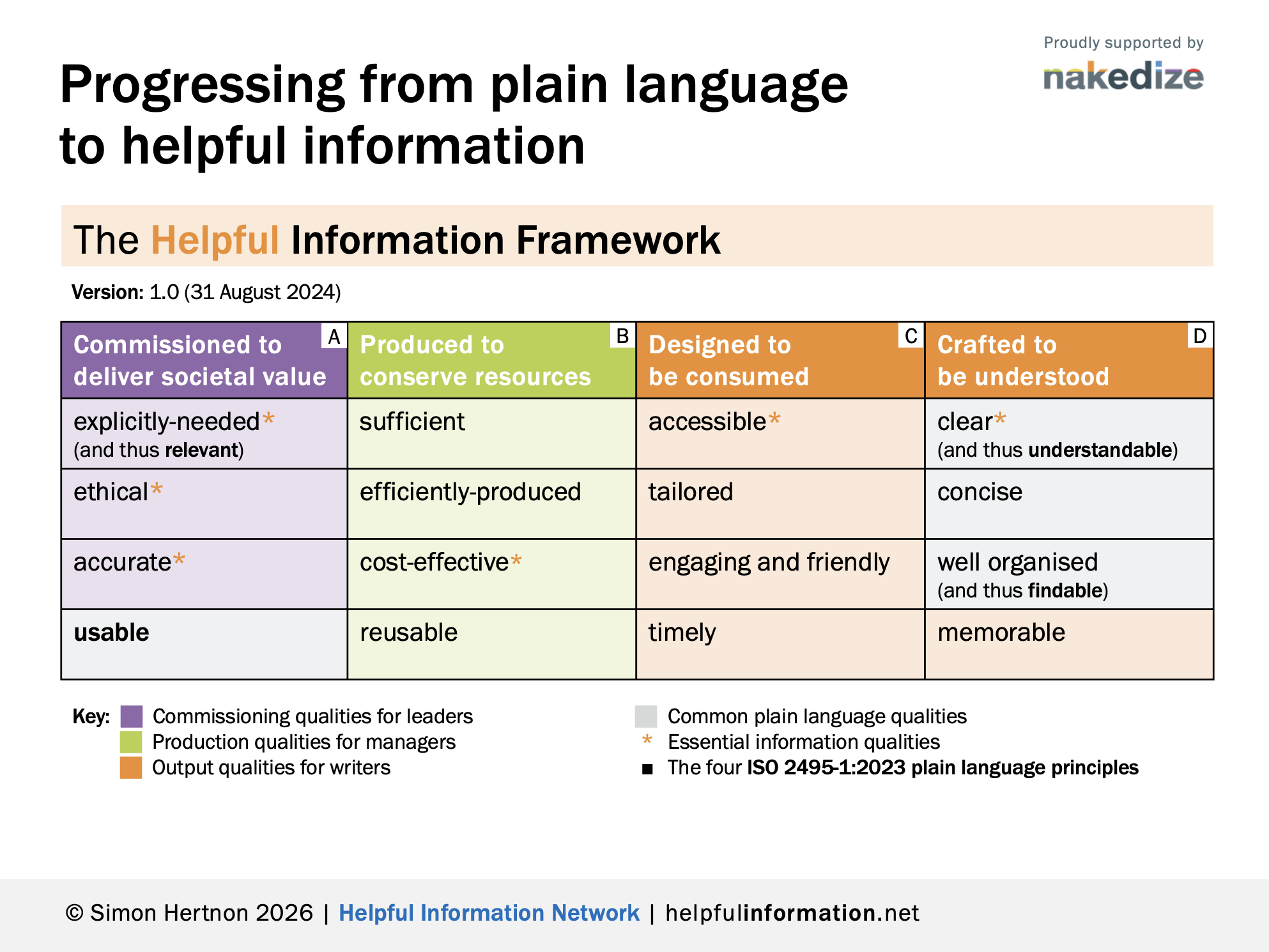
The Helpful Information Framework (accessible table) version 1.0 (31 August 2026)
| [A] Commissioned to deliver societal value | [B] Produced to conserve resources | [C] Designed to be consumed | [D] Crafted to be understood |
|---|---|---|---|
| explicitly-needed first of six essential qualities (and thus relevant) | sufficient | accessible* fifth of six essential qualities | clear* sixth of five essential qualities (and thus understandable) |
| ethical* second of six essential qualities | efficiently-produced | tailored | concise |
| accurate* third of six essential qualities | cost-effective* fourth of six essential qualities | engaging and friendly | well organised (and thus findable) |
| usable | reusable | timely | memorable |
* Essential qualities
Copyright © Simon Hertnon 2026
Note, only four (bolded) qualities are common plain language qualities as defined by the 2023 ISO Plain Language Standard (ISO 24495-1) and New Zealand’s Plain Language Act 2022.
Who is the framework for?
I have designed the framework for absolutely every one of us because we all need to think about society’s need for and relationship with information.
The four key audiences (across private, public, and non-profit domains) are:
- Leaders
Because they set the information culture in their organisations – if leaders only want their organisations to produce and consume helpful information, then that’s what will happen. - Managers
Because very few managers are schooled in information production, let alone purposeful, effective, efficient information production. - Writers
Because the qualities can help us to write better, and the process and roles can help us to persuade leaders and managers to consistently play their parts. - Plain language (and other clear communication) practitioners
Because our profession has always wanted information to be helpful to society and having a framework that explicitly makes information quality everyone’s business can only enhance our work and impact.
How can the framework be used?
The framework can be used as a:
- de facto writing standard
- process checklist including:
- commissioning prompts (for leaders and managers)
- briefing and document production prompts (for managers)
- writing prompts (for writers)
- project focus tool
- eg, for ranking what’s in scope or what’s most important
- document rating tool
- eg, one point for every quality met
- conversation starter about:
- information culture (both organisational and societal)
- information value (sustainable information)
Is there a management course to learn how to commission helpful information and manage its production?
Yes. I have replaced Nakedize’s one-day Improving Document Production course with a condensed half-day course titled Management Essentials for Producing Helpful Information.
Course outline coming soon.
Is there a writing course to learn how to design and craft helpful information?
Yes. I have redeveloped Nakedize’s flagship one-day Writing Essentials course – now renamed Writing Essentials for Producing Helpful Information – to embed and make full use of the new framework.
Does Nakedize own the framework?
No. The copyright belongs to me, personally. This is to enable the framework to flourish as part of an unlimited public-good initiative, rather than be limited as a commercial asset.
Nakedize has effectively sponsored the initial development phase of the framework, which has concluded today, Monday 31 August, following the presentation I have just given to the Victorian Government’s 2000-member Plain Language Community of Practice.
From next month (September 2026), I will begin offering Nakedize training and consultancy services to support organisations to produce helpful information.
These services are not intended to be exclusive. Instead, I intend to collaborate closely with my plain language colleagues at Write Group (and with other plain language practitioners across Aotearoa, Australia, and the world) to ensure helpful information services become widely available.
Is the framework free for anyone to use, publish, or modify?
Right now, anyone can use the framework as presented on this page, but that’s it.
Here’s what’s coming next:
- Downloadable PDF
From 7 September, the new framework will be available on this web page as a downloadable PDF (on provision of your name and email address). - Donations to fund more collaboration and development
During September, a koha (gift, donation) option will be added to the PDF download page to support establishment of the Helpful Information Network (see the next Q&A) as part of a broader ‘Same Page Initiative’. Funds will go to the Same Page Foundation, which is an unregistered charity I have designed that (subject to acceptance) will initially operate as a ‘collective’ under The Gift Trust’s (CC40774) Gift Collective fundholding project.
So, please, make use of the framework, review it, post about it, but don’t publish it in your own materials or on your own web site without my permission. Once the Helpful Information Network is established, modifications and publication guidelines (or rules) can be developed collegially.
What is the Helpful Information Network?
Helpful Information Network is the name I have given to the global professional development network I am seeding to:
- promote the need for helpful information
- develop the practice of producing helpful information
- develop materials to support training and adoption
- develop publishing guidelines (or rules)
- receive and respond to feedback and suggestions
The network is already provisionally operating through a year of collaborations with the Victorian Government’s outstanding Plain Language Community of Practice and, more recently, with Write Group, who facilitate a New Zealand Plain Language Community of Practice and who are New Zealand’s premier plain language champions.
As outlined above, initial funding to set up the network will hopefully come from koha (gifts, donations) received from people who download the Helpful Information Framework.
Background information
If you are hungry to learn more…
- How unhelpful information is blocking global sustainability
- Rationale and provenance
- Next steps – what I’m working on
- Contact Simon
How unhelpful information is blocking global sustainability
I’m proud to reveal that Nakedize is evolving into a sustainability practice focused on information.
This repositioning is because of a crucial and urgent societal need for what I’m calling ‘helpful information’.
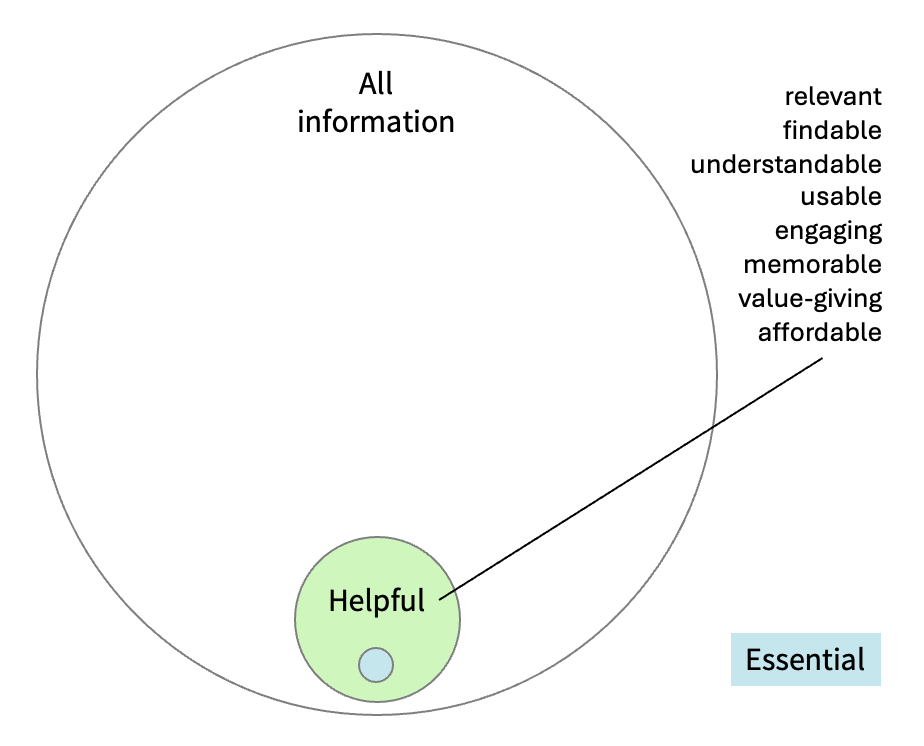
Global society is suffering from an ever-increasing flood of low-or-no-value information that buries, obscures, and dilutes the relatively small amount of helpful and essential information humans need to live sustainably. This wasteful oversupply also consumes most of our finite attention, leaving little left for absorbing helpful or essential information.
This 24/7 deluge is today exponentially inflated by AI misuse and overuse. Most of us are highly occupied interacting with information, but we can consume only fragments and can retain even less. Pouring water into a full glass is not progress, its wastefulness.
Information should enable us to live better lives but, instead, it is directly leading to us being increasingly distracted, divided, and overwhelmed.
For a society to survive and thrive, its citizens must know how to live well, and then direct their energy and effort to collaboratively putting that knowledge into practice. We know lots of things and have access to extreme amounts of information, but we clearly don’t know how to live well in a way that (to quote the UN) meets ‘the needs of the present without compromising the ability of future generations to meet their own needs’.
Instead, our global society suffers from a ‘polycrisis’ that includes climate change, ecological degradation, social and political instability, and extreme inequality.
The Helpful Information Framework is my response to a societal relationship with information that keeps us on the path to collapse.
Rationale and provenance
For more than 20 years, I have been teaching knowledge workers how to think more and write less – and better – so they can deliver more value to their organisations and, through them, to society.
For around 15 years, I have developed my reputation as a plain language professional, because plain language practice is all about creating information that is clear to the audience who needs the information.
But I have always felt that plain language doesn’t go far enough because, for example, clear information (crafted in plain language) can also be unneeded, unethical, inaccurate, and so on.
This is why I have always specialised in one-pagers specifically, and concise information generally. Concise information leaves out the fluff that wastes time, puts off readers, and reduces comprehensibility and transparency. In both the private and public sectors, concise writing is generally more attractive, engaging, helpful, and cost-effective.
And while I don’t know of a single plain language practitioner who uses their skills to deliberately create unhelpful information, the holes in plain language definitions remain.
Every day, advertisers, marketers, journalists, politicians, corporations, influencers, and others create clear information that could be categorised as plain language, even though the information is unneeded, or unethical, or inaccurate, or a combination of those negative qualities.
Meanwhile, given that the human brain has a limited capacity for processing information, it must also be true that if global society is producing ever-increasing quantities of unhelpful information, then there must be an ever-decreasing availability of attention for us to consume and make use of the helpful information we really need.
An intervention is needed, and this framework is the simplest intervention I could think of. It gets the unnamed, unmeasured and, thus, unsought qualities out in the open. It makes information quality and utility everyone’s business, prompting discussion between writers, managers, and leaders so, together, we efficiently create the information society really needs.
Next steps – what I’m working on
I am working on a suite of rating and measurement tools – based on the Helpful Information Framework – that will enable any organisation to track progress on the helpfulness of:
- its overarching information culture
- its information production and management systems
- its overall information stock
- individual information items
I am also:
- redeveloping Nakedize’s three consultancy services to embed and make full use of the framework
- evolving (since May) Nakedize’s Optimal Information consultancy service to embed the Helpful Information Framework through ongoing work for a high-profile New Zealand client (announcement coming soon)
- liaising with my awesome colleagues at Kāpuhipuhi Wellington Uni Professional about:
- resuming (next year) my redeveloped Writing Essentials public course (provisionally retitled Writing Essentials for Producing Helpful Information)
- delivering (next year) a second course for leaders and managers (provisionally titled Management Essentials for Producing Helpful Information)
- completing the rebuild of this web site (so it meets the framework’s de facto standard!)

Contact Simon
Please contact me if you have any questions, or you wish to be involved in developing the framework and its practical implementation.